http://10.186.108.24/wiki/api.php?action=feedcontributions&feedformat=atom&user=Pangewiki - User contributions [en]2026-10-17T01:51:04ZUser contributionsMediaWiki 1.26.0http://10.186.108.24/wiki/index.php?title=Molten_Salt_Material&diff=107Molten Salt Material2020-07-10T02:56:17Z<p>Pange: </p>
<hr />
<div>=== Background ===<br />
Molten salts are promising thermal energy storage(TES)materials. Thermophysical properties of molten halide salts closely related to device and system design should be determined accurately covering the entire operating temperature range. Although multi-components salts are actually used, structural and thermophysical properties of pure salts are essential for complementing the basic thermodynamic data and developing new type halide materials. Moreover, thermophysical properties of multi-components salts can be roughly estimated without any experiments by additive principle7 and other expirical methods8 where the corresponding properties of individual components are needed in case someone has no experimental conditions. Furthermore, in order to elucidate evolution law of thermophysical properties of molten halide salts with temperature, microstructures should be either measured or simulated. Unfortunately, to our best knowledge, some thermophysical properties are hard to measure by experiment so far. As an alternative, molecular simulations have been proposed and used to predict thermal and transport properties over the entire operating temperature range.<br />
<br />
=== Results ===<br />
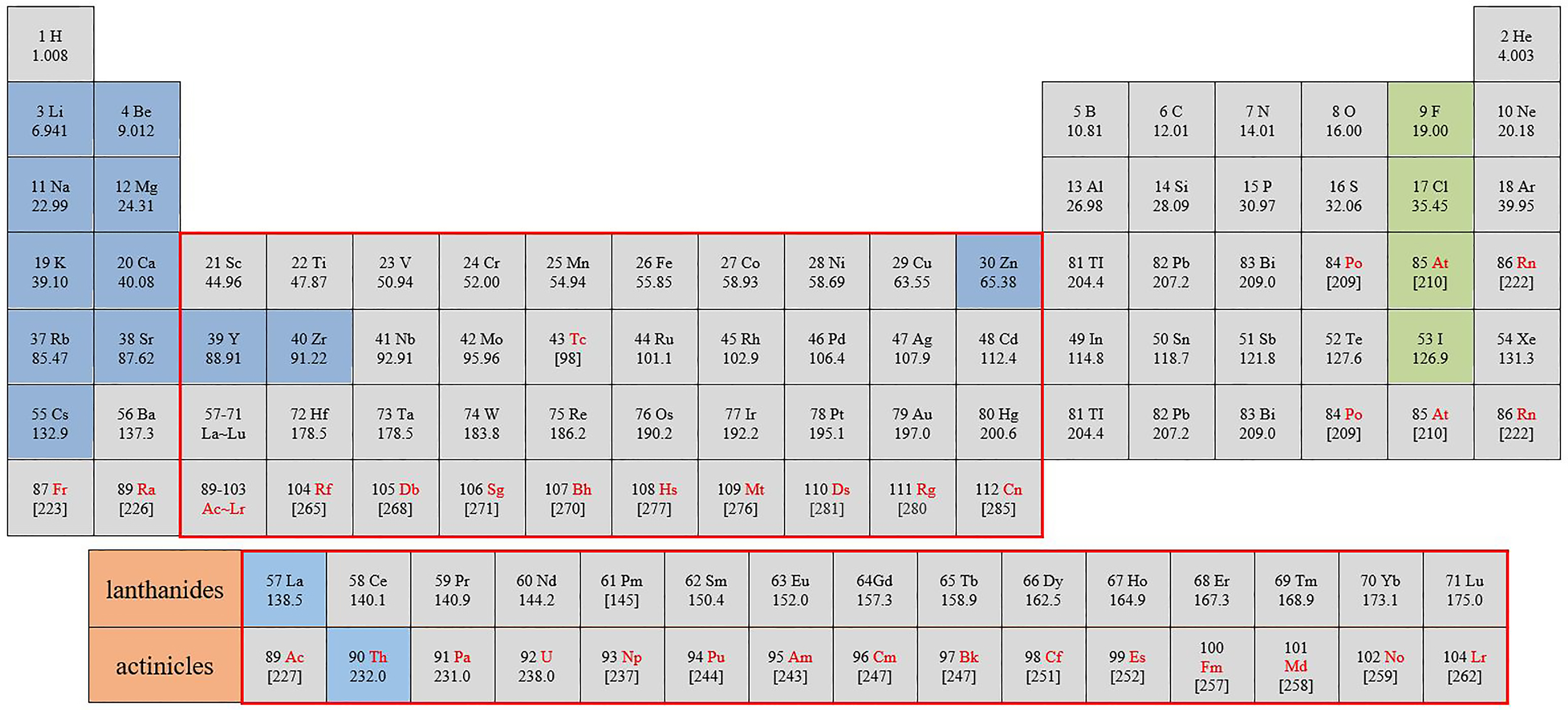
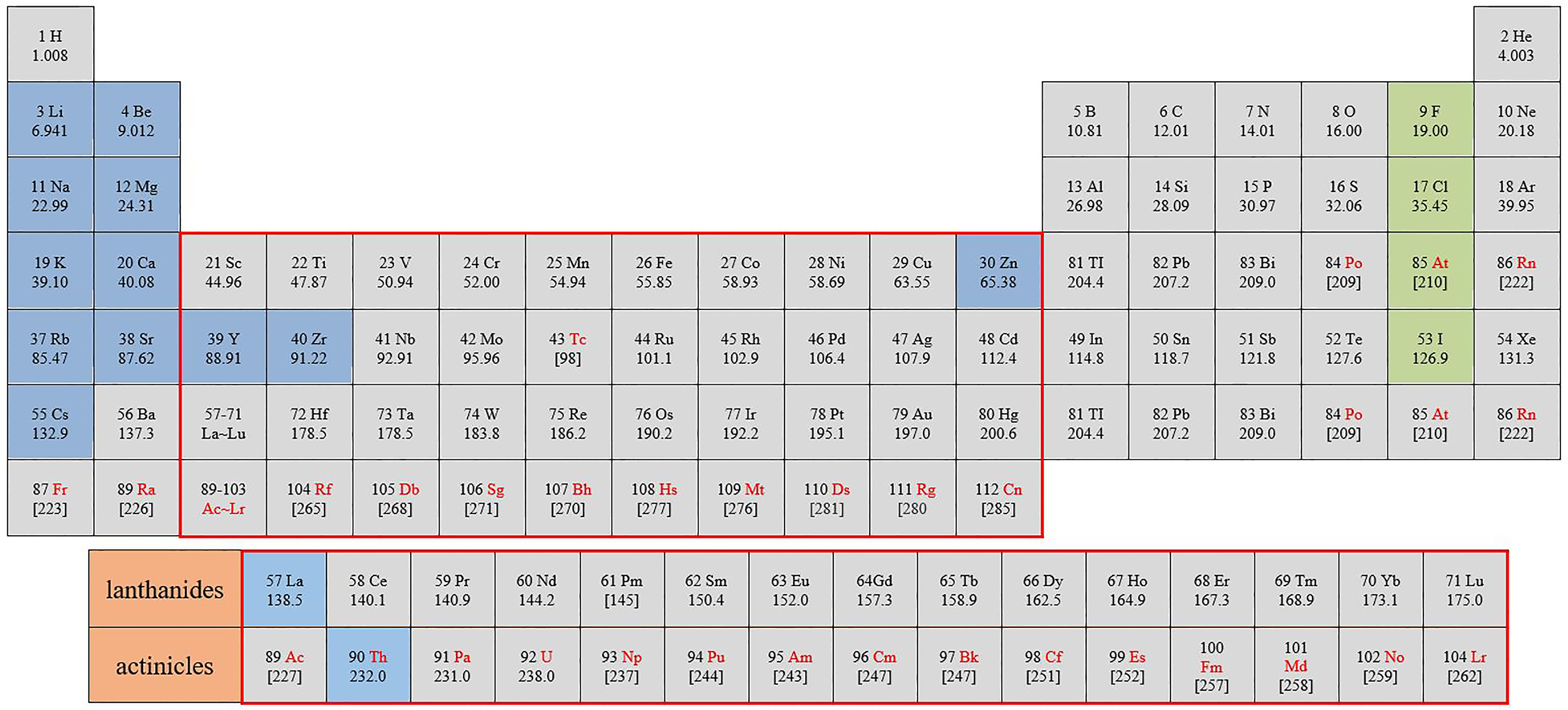
In this work, we use high-throughput molecular dynamics (HT-MD) to compute thermophysical properties and microstructure information of molten halide salts in an exhaustive manner. Thirty MXn systems are simulated in total. Of which cations cover majority of group I and II and minority of transition metal elements, lanthanides and actinicles while anions cover majority of halogen (see Fig. 1 (https://github.com/pangchq/Molten-Salt-Simulation-Toolkit/raw/master/Fig.1.jpg)<br />
). Thermophysical properties (~2,500) including constant pressure specific heat capacity, density, thermal expansion coefficient, self-diffusion coefficient, and viscosity as well as microstructure information including partial radial distribution function and coordination curve under atmospheric pressure condition are obtained with respect to different temperature. These calculations are automated using our own code, Molten Salt Simulation Toolkit (MSST), developed at the National Supercomputer Center in Guangzhou. MSST is built upon Tianhe-2 high-performance computing (HPC) clusters and can automatically handle input/output processing of CP2K molecular dynamics and manage job submission to cluster queues. Fig. 2 shows the workflow used to implement the HT-MD. (https://raw.githubusercontent.com/pangchq/Molten-Salt-Simulation-Toolkit/master/Fig.2.jpg)<br />
<br />
=== Conclusions ===<br />
The simulated constant pressure specific heat capacity, density, viscosity, thermal expansion coefficient, self-diffusion coefficient, and microstructures are in good agreement with experimental values.<br />
<br />
=== Usage notes ===<br />
We recommend usage of the fitting formula of thermophysical properties in the database as some viscosities of simulations near the melting point are not very accurate due to the reason mentioned above. Researchers who concern the precision and would like to obtain more accurate results can rerun the code (https://github.com/pangchq/Molten-Salt-Simulation-Toolkit/) and increase the simulation time.</div>Pangehttp://10.186.108.24/wiki/index.php?title=Molten_Salt_Material&diff=106Molten Salt Material2020-07-10T02:47:57Z<p>Pange: </p>
<hr />
<div>=== Background ===<br />
Molten salts are promising thermal energy storage(TES)materials. Thermophysical properties of molten halide salts closely related to device and system design should be determined accurately covering the entire operating temperature range. Although multi-components salts are actually used, structural and thermophysical properties of pure salts are essential for complementing the basic thermodynamic data and developing new type halide materials. Moreover, thermophysical properties of multi-components salts can be roughly estimated without any experiments by additive principle7 and other expirical methods8 where the corresponding properties of individual components are needed in case someone has no experimental conditions. Furthermore, in order to elucidate evolution law of thermophysical properties of molten halide salts with temperature, microstructures should be either measured or simulated. Unfortunately, to our best knowledge, some thermophysical properties are hard to measure by experiment so far. As an alternative, molecular simulations have been proposed and used to predict thermal and transport properties over the entire operating temperature range.<br />
<br />
=== Results ===<br />
In this work, we use high-throughput molecular dynamics (HT-MD) to compute thermophysical properties and microstructure information of molten halide salts in an exhaustive manner. Thirty MXn systems are simulated in total. Of which cations cover majority of group I and II and minority of transition metal elements, lanthanides and actinicles while anions cover majority of halogen (see *Fig. 1* (https://github.com/pangchq/Molten-Salt-Simulation-Toolkit/raw/master/Fig.1.jpg)<br />
). Thermophysical properties (~2,500) including constant pressure specific heat capacity, density, thermal expansion coefficient, self-diffusion coefficient, and viscosity as well as microstructure information including partial radial distribution function and coordination curve under atmospheric pressure condition are obtained with respect to different temperature. These calculations are automated using our own code, Molten Salt Simulation Toolkit (MSST), developed at the National Supercomputer Center in Guangzhou. MSST is built upon Tianhe-2 high-performance computing (HPC) clusters and can automatically handle input/output processing of CP2K molecular dynamics and manage job submission to cluster queues. Fig. 2 shows the workflow used to implement the HT-MD. (https://raw.githubusercontent.com/pangchq/Molten-Salt-Simulation-Toolkit/master/Fig.2.jpg)<br />
<br />
=== Conclusions ===</div>Pangehttp://10.186.108.24/wiki/index.php?title=Molten_Salt_Material&diff=105Molten Salt Material2020-07-10T02:46:27Z<p>Pange: /* Results */</p>
<hr />
<div>=== Background ===<br />
Molten salts are promising thermal energy storage(TES)materials. Thermophysical properties of molten halide salts closely related to device and system design should be determined accurately covering the entire operating temperature range. Although multi-components salts are actually used, structural and thermophysical properties of pure salts are essential for complementing the basic thermodynamic data and developing new type halide materials. Moreover, thermophysical properties of multi-components salts can be roughly estimated without any experiments by additive principle7 and other expirical methods8 where the corresponding properties of individual components are needed in case someone has no experimental conditions. Furthermore, in order to elucidate evolution law of thermophysical properties of molten halide salts with temperature, microstructures should be either measured or simulated. Unfortunately, to our best knowledge, some thermophysical properties are hard to measure by experiment so far. As an alternative, molecular simulations have been proposed and used to predict thermal and transport properties over the entire operating temperature range.<br />
<br />
=== Results===<br />
In this work, we use high-throughput molecular dynamics (HT-MD) to compute thermophysical properties and microstructure information of molten halide salts in an exhaustive manner. Thirty MXn systems are simulated in total. Of which cations cover majority of group I and II and minority of transition metal elements, lanthanides and actinicles while anions cover majority of halogen (see Fig. 1 (https://github.com/pangchq/Molten-Salt-Simulation-Toolkit/raw/master/Fig.1.jpg)<br />
). Thermophysical properties (~2,500) including constant pressure specific heat capacity, density, thermal expansion coefficient, self-diffusion coefficient, and viscosity as well as microstructure information including partial radial distribution function and coordination curve under atmospheric pressure condition are obtained with respect to different temperature. These calculations are automated using our own code, Molten Salt Simulation Toolkit (MSST), developed at the National Supercomputer Center in Guangzhou. MSST is built upon Tianhe-2 high-performance computing (HPC) clusters and can automatically handle input/output processing of CP2K molecular dynamics and manage job submission to cluster queues. Fig. 2 shows the workflow used to implement the HT-MD. (https://raw.githubusercontent.com/pangchq/Molten-Salt-Simulation-Toolkit/master/Fig.2.jpg)</div>Pangehttp://10.186.108.24/wiki/index.php?title=Molten_Salt_Material&diff=104Molten Salt Material2020-07-10T02:45:40Z<p>Pange: /* Results */</p>
<hr />
<div>=== Background ===<br />
Molten salts are promising thermal energy storage(TES)materials. Thermophysical properties of molten halide salts closely related to device and system design should be determined accurately covering the entire operating temperature range. Although multi-components salts are actually used, structural and thermophysical properties of pure salts are essential for complementing the basic thermodynamic data and developing new type halide materials. Moreover, thermophysical properties of multi-components salts can be roughly estimated without any experiments by additive principle7 and other expirical methods8 where the corresponding properties of individual components are needed in case someone has no experimental conditions. Furthermore, in order to elucidate evolution law of thermophysical properties of molten halide salts with temperature, microstructures should be either measured or simulated. Unfortunately, to our best knowledge, some thermophysical properties are hard to measure by experiment so far. As an alternative, molecular simulations have been proposed and used to predict thermal and transport properties over the entire operating temperature range.<br />
<br />
=== Results===<br />
In this work, we use high-throughput molecular dynamics (HT-MD) to compute thermophysical properties and microstructure information of molten halide salts in an exhaustive manner. Thirty MXn systems are simulated in total. Of which cations cover majority of group I and II and minority of transition metal elements, lanthanides and actinicles while anions cover majority of halogen (see Fig. 1). Thermophysical properties (~2,500) including constant pressure specific heat capacity, density, thermal expansion coefficient, self-diffusion coefficient, and viscosity as well as microstructure information including partial radial distribution function and coordination curve under atmospheric pressure condition are obtained with respect to different temperature. These calculations are automated using our own code, Molten Salt Simulation Toolkit (MSST), developed at the National Supercomputer Center in Guangzhou. MSST is built upon Tianhe-2 high-performance computing (HPC) clusters and can automatically handle input/output processing of CP2K molecular dynamics and manage job submission to cluster queues. Fig. 2 shows the workflow used to implement the HT-MD.<br />
(https://github.com/pangchq/Molten-Salt-Simulation-Toolkit/raw/master/Fig.1.jpg)</div>Pangehttp://10.186.108.24/wiki/index.php?title=Molten_Salt_Material&diff=103Molten Salt Material2020-07-10T02:37:34Z<p>Pange: /* Results */</p>
<hr />
<div>=== Background ===<br />
Molten salts are promising thermal energy storage(TES)materials. Thermophysical properties of molten halide salts closely related to device and system design should be determined accurately covering the entire operating temperature range. Although multi-components salts are actually used, structural and thermophysical properties of pure salts are essential for complementing the basic thermodynamic data and developing new type halide materials. Moreover, thermophysical properties of multi-components salts can be roughly estimated without any experiments by additive principle7 and other expirical methods8 where the corresponding properties of individual components are needed in case someone has no experimental conditions. Furthermore, in order to elucidate evolution law of thermophysical properties of molten halide salts with temperature, microstructures should be either measured or simulated. Unfortunately, to our best knowledge, some thermophysical properties are hard to measure by experiment so far. As an alternative, molecular simulations have been proposed and used to predict thermal and transport properties over the entire operating temperature range.<br />
<br />
=== Results===<br />
In this work, we use high-throughput molecular dynamics (HT-MD) to compute thermophysical properties and microstructure information of molten halide salts in an exhaustive manner. Thirty MXn systems are simulated in total. Of which cations cover majority of group I and II and minority of transition metal elements, lanthanides and actinicles while anions cover majority of halogen (see Fig. 1). Thermophysical properties (~2,500) including constant pressure specific heat capacity, density, thermal expansion coefficient, self-diffusion coefficient, and viscosity as well as microstructure information including partial radial distribution function and coordination curve under atmospheric pressure condition are obtained with respect to different temperature. These calculations are automated using our own code, Molten Salt Simulation Toolkit (MSST), developed at the National Supercomputer Center in Guangzhou. MSST is built upon Tianhe-2 high-performance computing (HPC) clusters and can automatically handle input/output processing of CP2K molecular dynamics and manage job submission to cluster queues. Fig. 2 shows the workflow used to implement the HT-MD.<br />
</div>Pangehttp://10.186.108.24/wiki/index.php?title=Molten_Salt_Material&diff=102Molten Salt Material2020-07-10T02:37:05Z<p>Pange: /* Results */</p>
<hr />
<div>=== Background ===<br />
Molten salts are promising thermal energy storage(TES)materials. Thermophysical properties of molten halide salts closely related to device and system design should be determined accurately covering the entire operating temperature range. Although multi-components salts are actually used, structural and thermophysical properties of pure salts are essential for complementing the basic thermodynamic data and developing new type halide materials. Moreover, thermophysical properties of multi-components salts can be roughly estimated without any experiments by additive principle7 and other expirical methods8 where the corresponding properties of individual components are needed in case someone has no experimental conditions. Furthermore, in order to elucidate evolution law of thermophysical properties of molten halide salts with temperature, microstructures should be either measured or simulated. Unfortunately, to our best knowledge, some thermophysical properties are hard to measure by experiment so far. As an alternative, molecular simulations have been proposed and used to predict thermal and transport properties over the entire operating temperature range.<br />
<br />
=== Results===<br />
In this work, we use high-throughput molecular dynamics (HT-MD) to compute thermophysical properties and microstructure information of molten halide salts in an exhaustive manner. Thirty MXn systems are simulated in total. Of which cations cover majority of group I and II and minority of transition metal elements, lanthanides and actinicles while anions cover majority of halogen (see Fig. 1). Thermophysical properties (~2,500) including constant pressure specific heat capacity, density, thermal expansion coefficient, self-diffusion coefficient, and viscosity as well as microstructure information including partial radial distribution function and coordination curve under atmospheric pressure condition are obtained with respect to different temperature. These calculations are automated using our own code, Molten Salt Simulation Toolkit (MSST), developed at the National Supercomputer Center in Guangzhou. MSST is built upon Tianhe-2 high-performance computing (HPC) clusters and can automatically handle input/output processing of CP2K molecular dynamics and manage job submission to cluster queues. Fig. 2 shows the workflow used to implement the HT-MD.<br />
</div>Pangehttp://10.186.108.24/wiki/index.php?title=Molten_Salt_Material&diff=101Molten Salt Material2020-07-10T02:35:17Z<p>Pange: /* Results */</p>
<hr />
<div>=== Background ===<br />
Molten salts are promising thermal energy storage(TES)materials. Thermophysical properties of molten halide salts closely related to device and system design should be determined accurately covering the entire operating temperature range. Although multi-components salts are actually used, structural and thermophysical properties of pure salts are essential for complementing the basic thermodynamic data and developing new type halide materials. Moreover, thermophysical properties of multi-components salts can be roughly estimated without any experiments by additive principle7 and other expirical methods8 where the corresponding properties of individual components are needed in case someone has no experimental conditions. Furthermore, in order to elucidate evolution law of thermophysical properties of molten halide salts with temperature, microstructures should be either measured or simulated. Unfortunately, to our best knowledge, some thermophysical properties are hard to measure by experiment so far. As an alternative, molecular simulations have been proposed and used to predict thermal and transport properties over the entire operating temperature range.<br />
<br />
=== Results===<br />
In this work, we use high-throughput molecular dynamics (HT-MD) to compute thermophysical properties and microstructure information of molten halide salts in an exhaustive manner. Thirty MXn systems are simulated in total. Of which cations cover majority of group I and II and minority of transition metal elements, lanthanides and actinicles while anions cover majority of halogen (see Fig. 1). Thermophysical properties (~2,500) including constant pressure specific heat capacity, density, thermal expansion coefficient, self-diffusion coefficient, and viscosity as well as microstructure information including partial radial distribution function and coordination curve under atmospheric pressure condition are obtained with respect to different temperature. These calculations are automated using our own code, Molten Salt Simulation Toolkit (MSST), developed at the National Supercomputer Center in Guangzhou. MSST is built upon Tianhe-2 high-performance computing (HPC) clusters and can automatically handle input/output processing of CP2K molecular dynamics and manage job submission to cluster queues. Fig. 2 shows the workflow used to implement the HT-MD.<br />
</div>Pangehttp://10.186.108.24/wiki/index.php?title=Molten_Salt_Material&diff=100Molten Salt Material2020-07-10T02:34:02Z<p>Pange: /* Results */</p>
<hr />
<div>=== Background ===<br />
Molten salts are promising thermal energy storage(TES)materials. Thermophysical properties of molten halide salts closely related to device and system design should be determined accurately covering the entire operating temperature range. Although multi-components salts are actually used, structural and thermophysical properties of pure salts are essential for complementing the basic thermodynamic data and developing new type halide materials. Moreover, thermophysical properties of multi-components salts can be roughly estimated without any experiments by additive principle7 and other expirical methods8 where the corresponding properties of individual components are needed in case someone has no experimental conditions. Furthermore, in order to elucidate evolution law of thermophysical properties of molten halide salts with temperature, microstructures should be either measured or simulated. Unfortunately, to our best knowledge, some thermophysical properties are hard to measure by experiment so far. As an alternative, molecular simulations have been proposed and used to predict thermal and transport properties over the entire operating temperature range.<br />
<br />
=== Results===<br />
In this work, we use high-throughput molecular dynamics (HT-MD) to compute thermophysical properties and microstructure information of molten halide salts in an exhaustive manner. Thirty MXn systems are simulated in total. Of which cations cover majority of group I and II and minority of transition metal elements, lanthanides and actinicles while anions cover majority of halogen (see Fig. 1). Thermophysical properties (~2,500) including constant pressure specific heat capacity, density, thermal expansion coefficient, self-diffusion coefficient, and viscosity as well as microstructure information including partial radial distribution function and coordination curve under atmospheric pressure condition are obtained with respect to different temperature. These calculations are automated using our own code, Molten Salt Simulation Toolkit (MSST), developed at the National Supercomputer Center in Guangzhou. MSST is built upon Tianhe-2 high-performance computing (HPC) clusters and can automatically handle input/output processing of CP2K molecular dynamics and manage job submission to cluster queues. Fig. 2 shows the workflow used to implement the HT-MD.<br />
!(https://github.com/pangchq/Molten-Salt-Simulation-Toolkit/master/Fig.1.jpg?raw=true)</div>Pangehttp://10.186.108.24/wiki/index.php?title=Molten_Salt_Material&diff=99Molten Salt Material2020-07-10T02:33:20Z<p>Pange: /* Results */</p>
<hr />
<div>=== Background ===<br />
Molten salts are promising thermal energy storage(TES)materials. Thermophysical properties of molten halide salts closely related to device and system design should be determined accurately covering the entire operating temperature range. Although multi-components salts are actually used, structural and thermophysical properties of pure salts are essential for complementing the basic thermodynamic data and developing new type halide materials. Moreover, thermophysical properties of multi-components salts can be roughly estimated without any experiments by additive principle7 and other expirical methods8 where the corresponding properties of individual components are needed in case someone has no experimental conditions. Furthermore, in order to elucidate evolution law of thermophysical properties of molten halide salts with temperature, microstructures should be either measured or simulated. Unfortunately, to our best knowledge, some thermophysical properties are hard to measure by experiment so far. As an alternative, molecular simulations have been proposed and used to predict thermal and transport properties over the entire operating temperature range.<br />
<br />
=== Results===<br />
In this work, we use high-throughput molecular dynamics (HT-MD) to compute thermophysical properties and microstructure information of molten halide salts in an exhaustive manner. Thirty MXn systems are simulated in total. Of which cations cover majority of group I and II and minority of transition metal elements, lanthanides and actinicles while anions cover majority of halogen (see Fig. 1). Thermophysical properties (~2,500) including constant pressure specific heat capacity, density, thermal expansion coefficient, self-diffusion coefficient, and viscosity as well as microstructure information including partial radial distribution function and coordination curve under atmospheric pressure condition are obtained with respect to different temperature. These calculations are automated using our own code, Molten Salt Simulation Toolkit (MSST), developed at the National Supercomputer Center in Guangzhou. MSST is built upon Tianhe-2 high-performance computing (HPC) clusters and can automatically handle input/output processing of CP2K molecular dynamics and manage job submission to cluster queues. Fig. 2 shows the workflow used to implement the HT-MD.<br />
!(https://raw.githubusercontent.com/pangchq/Molten-Salt-Simulation-Toolkit/master/Fig.1.jpg?raw=true)</div>Pangehttp://10.186.108.24/wiki/index.php?title=Molten_Salt_Material&diff=98Molten Salt Material2020-07-10T02:32:45Z<p>Pange: /* Results */</p>
<hr />
<div>=== Background ===<br />
Molten salts are promising thermal energy storage(TES)materials. Thermophysical properties of molten halide salts closely related to device and system design should be determined accurately covering the entire operating temperature range. Although multi-components salts are actually used, structural and thermophysical properties of pure salts are essential for complementing the basic thermodynamic data and developing new type halide materials. Moreover, thermophysical properties of multi-components salts can be roughly estimated without any experiments by additive principle7 and other expirical methods8 where the corresponding properties of individual components are needed in case someone has no experimental conditions. Furthermore, in order to elucidate evolution law of thermophysical properties of molten halide salts with temperature, microstructures should be either measured or simulated. Unfortunately, to our best knowledge, some thermophysical properties are hard to measure by experiment so far. As an alternative, molecular simulations have been proposed and used to predict thermal and transport properties over the entire operating temperature range.<br />
<br />
=== Results===<br />
In this work, we use high-throughput molecular dynamics (HT-MD) to compute thermophysical properties and microstructure information of molten halide salts in an exhaustive manner. Thirty MXn systems are simulated in total. Of which cations cover majority of group I and II and minority of transition metal elements, lanthanides and actinicles while anions cover majority of halogen (see Fig. 1). Thermophysical properties (~2,500) including constant pressure specific heat capacity, density, thermal expansion coefficient, self-diffusion coefficient, and viscosity as well as microstructure information including partial radial distribution function and coordination curve under atmospheric pressure condition are obtained with respect to different temperature. These calculations are automated using our own code, Molten Salt Simulation Toolkit (MSST), developed at the National Supercomputer Center in Guangzhou. MSST is built upon Tianhe-2 high-performance computing (HPC) clusters and can automatically handle input/output processing of CP2K molecular dynamics and manage job submission to cluster queues. Fig. 2 shows the workflow used to implement the HT-MD.<br />
</div>Pangehttp://10.186.108.24/wiki/index.php?title=Molten_Salt_Material&diff=97Molten Salt Material2020-07-10T02:25:01Z<p>Pange: /* Results */</p>
<hr />
<div>=== Background ===<br />
Molten salts are promising thermal energy storage(TES)materials. Thermophysical properties of molten halide salts closely related to device and system design should be determined accurately covering the entire operating temperature range. Although multi-components salts are actually used, structural and thermophysical properties of pure salts are essential for complementing the basic thermodynamic data and developing new type halide materials. Moreover, thermophysical properties of multi-components salts can be roughly estimated without any experiments by additive principle7 and other expirical methods8 where the corresponding properties of individual components are needed in case someone has no experimental conditions. Furthermore, in order to elucidate evolution law of thermophysical properties of molten halide salts with temperature, microstructures should be either measured or simulated. Unfortunately, to our best knowledge, some thermophysical properties are hard to measure by experiment so far. As an alternative, molecular simulations have been proposed and used to predict thermal and transport properties over the entire operating temperature range.<br />
<br />
=== Results===<br />
In this work, we use high-throughput molecular dynamics (HT-MD) to compute thermophysical properties and microstructure information of molten halide salts in an exhaustive manner. Thirty MXn systems are simulated in total. Of which cations cover majority of group I and II and minority of transition metal elements, lanthanides and actinicles while anions cover majority of halogen (see Fig. 1). Thermophysical properties (~2,500) including constant pressure specific heat capacity, density, thermal expansion coefficient, self-diffusion coefficient, and viscosity as well as microstructure information including partial radial distribution function and coordination curve under atmospheric pressure condition are obtained with respect to different temperature. These calculations are automated using our own code, Molten Salt Simulation Toolkit (MSST), developed at the National Supercomputer Center in Guangzhou. MSST is built upon Tianhe-2 high-performance computing (HPC) clusters and can automatically handle input/output processing of CP2K molecular dynamics and manage job submission to cluster queues. Fig. 2 shows the workflow used to implement the HT-MD.<br />
https://github.com/pangchq/Molten-Salt-Simulation-Toolkit/raw/master/Fig.1.tif</div>Pangehttp://10.186.108.24/wiki/index.php?title=Molten_Salt_Material&diff=96Molten Salt Material2020-07-10T02:23:24Z<p>Pange: /* Results */</p>
<hr />
<div>=== Background ===<br />
Molten salts are promising thermal energy storage(TES)materials. Thermophysical properties of molten halide salts closely related to device and system design should be determined accurately covering the entire operating temperature range. Although multi-components salts are actually used, structural and thermophysical properties of pure salts are essential for complementing the basic thermodynamic data and developing new type halide materials. Moreover, thermophysical properties of multi-components salts can be roughly estimated without any experiments by additive principle7 and other expirical methods8 where the corresponding properties of individual components are needed in case someone has no experimental conditions. Furthermore, in order to elucidate evolution law of thermophysical properties of molten halide salts with temperature, microstructures should be either measured or simulated. Unfortunately, to our best knowledge, some thermophysical properties are hard to measure by experiment so far. As an alternative, molecular simulations have been proposed and used to predict thermal and transport properties over the entire operating temperature range.<br />
<br />
=== Results===<br />
In this work, we use high-throughput molecular dynamics (HT-MD) to compute thermophysical properties and microstructure information of molten halide salts in an exhaustive manner. Thirty MXn systems are simulated in total. Of which cations cover majority of group I and II and minority of transition metal elements, lanthanides and actinicles while anions cover majority of halogen (see Fig. 1). Thermophysical properties (~2,500) including constant pressure specific heat capacity, density, thermal expansion coefficient, self-diffusion coefficient, and viscosity as well as microstructure information including partial radial distribution function and coordination curve under atmospheric pressure condition are obtained with respect to different temperature. These calculations are automated using our own code, Molten Salt Simulation Toolkit (MSST), developed at the National Supercomputer Center in Guangzhou. MSST is built upon Tianhe-2 high-performance computing (HPC) clusters and can automatically handle input/output processing of CP2K molecular dynamics and manage job submission to cluster queues. Fig. 2 shows the workflow used to implement the HT-MD.<br />
</div>Pangehttp://10.186.108.24/wiki/index.php?title=Molten_Salt_Material&diff=95Molten Salt Material2020-07-10T02:22:12Z<p>Pange: /* Results */</p>
<hr />
<div>=== Background ===<br />
Molten salts are promising thermal energy storage(TES)materials. Thermophysical properties of molten halide salts closely related to device and system design should be determined accurately covering the entire operating temperature range. Although multi-components salts are actually used, structural and thermophysical properties of pure salts are essential for complementing the basic thermodynamic data and developing new type halide materials. Moreover, thermophysical properties of multi-components salts can be roughly estimated without any experiments by additive principle7 and other expirical methods8 where the corresponding properties of individual components are needed in case someone has no experimental conditions. Furthermore, in order to elucidate evolution law of thermophysical properties of molten halide salts with temperature, microstructures should be either measured or simulated. Unfortunately, to our best knowledge, some thermophysical properties are hard to measure by experiment so far. As an alternative, molecular simulations have been proposed and used to predict thermal and transport properties over the entire operating temperature range.<br />
<br />
=== Results===<br />
In this work, we use high-throughput molecular dynamics (HT-MD) to compute thermophysical properties and microstructure information of molten halide salts in an exhaustive manner. Thirty MXn systems are simulated in total. Of which cations cover majority of group I and II and minority of transition metal elements, lanthanides and actinicles while anions cover majority of halogen (see Fig. 1). Thermophysical properties (~2,500) including constant pressure specific heat capacity, density, thermal expansion coefficient, self-diffusion coefficient, and viscosity as well as microstructure information including partial radial distribution function and coordination curve under atmospheric pressure condition are obtained with respect to different temperature. These calculations are automated using our own code, Molten Salt Simulation Toolkit (MSST), developed at the National Supercomputer Center in Guangzhou. MSST is built upon Tianhe-2 high-performance computing (HPC) clusters and can automatically handle input/output processing of CP2K molecular dynamics and manage job submission to cluster queues. Fig. 2 shows the workflow used to implement the HT-MD.<br />
</div>Pangehttp://10.186.108.24/wiki/index.php?title=Molten_Salt_Material&diff=94Molten Salt Material2020-07-10T02:21:27Z<p>Pange: /* Results */</p>
<hr />
<div>=== Background ===<br />
Molten salts are promising thermal energy storage(TES)materials. Thermophysical properties of molten halide salts closely related to device and system design should be determined accurately covering the entire operating temperature range. Although multi-components salts are actually used, structural and thermophysical properties of pure salts are essential for complementing the basic thermodynamic data and developing new type halide materials. Moreover, thermophysical properties of multi-components salts can be roughly estimated without any experiments by additive principle7 and other expirical methods8 where the corresponding properties of individual components are needed in case someone has no experimental conditions. Furthermore, in order to elucidate evolution law of thermophysical properties of molten halide salts with temperature, microstructures should be either measured or simulated. Unfortunately, to our best knowledge, some thermophysical properties are hard to measure by experiment so far. As an alternative, molecular simulations have been proposed and used to predict thermal and transport properties over the entire operating temperature range.<br />
<br />
=== Results===<br />
In this work, we use high-throughput molecular dynamics (HT-MD) to compute thermophysical properties and microstructure information of molten halide salts in an exhaustive manner. Thirty MXn systems are simulated in total. Of which cations cover majority of group I and II and minority of transition metal elements, lanthanides and actinicles while anions cover majority of halogen (see Fig. 1). Thermophysical properties (~2,500) including constant pressure specific heat capacity, density, thermal expansion coefficient, self-diffusion coefficient, and viscosity as well as microstructure information including partial radial distribution function and coordination curve under atmospheric pressure condition are obtained with respect to different temperature. These calculations are automated using our own code, Molten Salt Simulation Toolkit (MSST), developed at the National Supercomputer Center in Guangzhou. MSST is built upon Tianhe-2 high-performance computing (HPC) clusters and can automatically handle input/output processing of CP2K molecular dynamics and manage job submission to cluster queues. Fig. 2 shows the workflow used to implement the HT-MD.<br />
</div>Pangehttp://10.186.108.24/wiki/index.php?title=Molten_Salt_Material&diff=93Molten Salt Material2020-07-10T02:20:43Z<p>Pange: /* Results */</p>
<hr />
<div>=== Background ===<br />
Molten salts are promising thermal energy storage(TES)materials. Thermophysical properties of molten halide salts closely related to device and system design should be determined accurately covering the entire operating temperature range. Although multi-components salts are actually used, structural and thermophysical properties of pure salts are essential for complementing the basic thermodynamic data and developing new type halide materials. Moreover, thermophysical properties of multi-components salts can be roughly estimated without any experiments by additive principle7 and other expirical methods8 where the corresponding properties of individual components are needed in case someone has no experimental conditions. Furthermore, in order to elucidate evolution law of thermophysical properties of molten halide salts with temperature, microstructures should be either measured or simulated. Unfortunately, to our best knowledge, some thermophysical properties are hard to measure by experiment so far. As an alternative, molecular simulations have been proposed and used to predict thermal and transport properties over the entire operating temperature range.<br />
<br />
=== Results===<br />
In this work, we use high-throughput molecular dynamics (HT-MD) to compute thermophysical properties and microstructure information of molten halide salts in an exhaustive manner. Thirty MXn systems are simulated in total. Of which cations cover majority of group I and II and minority of transition metal elements, lanthanides and actinicles while anions cover majority of halogen (see Fig. 1). Thermophysical properties (~2,500) including constant pressure specific heat capacity, density, thermal expansion coefficient, self-diffusion coefficient, and viscosity as well as microstructure information including partial radial distribution function and coordination curve under atmospheric pressure condition are obtained with respect to different temperature. These calculations are automated using our own code, Molten Salt Simulation Toolkit (MSST), developed at the National Supercomputer Center in Guangzhou. MSST is built upon Tianhe-2 high-performance computing (HPC) clusters and can automatically handle input/output processing of CP2K molecular dynamics and manage job submission to cluster queues. Fig. 2 shows the workflow used to implement the HT-MD.<br />
[](https://github.com/pangchq/Molten-Salt-Simulation-Toolkit/blob/master/Fig.1.tif?raw=true)</div>Pangehttp://10.186.108.24/wiki/index.php?title=Molten_Salt_Material&diff=92Molten Salt Material2020-07-10T02:20:02Z<p>Pange: /* Results */</p>
<hr />
<div>=== Background ===<br />
Molten salts are promising thermal energy storage(TES)materials. Thermophysical properties of molten halide salts closely related to device and system design should be determined accurately covering the entire operating temperature range. Although multi-components salts are actually used, structural and thermophysical properties of pure salts are essential for complementing the basic thermodynamic data and developing new type halide materials. Moreover, thermophysical properties of multi-components salts can be roughly estimated without any experiments by additive principle7 and other expirical methods8 where the corresponding properties of individual components are needed in case someone has no experimental conditions. Furthermore, in order to elucidate evolution law of thermophysical properties of molten halide salts with temperature, microstructures should be either measured or simulated. Unfortunately, to our best knowledge, some thermophysical properties are hard to measure by experiment so far. As an alternative, molecular simulations have been proposed and used to predict thermal and transport properties over the entire operating temperature range.<br />
<br />
=== Results===<br />
In this work, we use high-throughput molecular dynamics (HT-MD) to compute thermophysical properties and microstructure information of molten halide salts in an exhaustive manner. Thirty MXn systems are simulated in total. Of which cations cover majority of group I and II and minority of transition metal elements, lanthanides and actinicles while anions cover majority of halogen (see Fig. 1). Thermophysical properties (~2,500) including constant pressure specific heat capacity, density, thermal expansion coefficient, self-diffusion coefficient, and viscosity as well as microstructure information including partial radial distribution function and coordination curve under atmospheric pressure condition are obtained with respect to different temperature. These calculations are automated using our own code, Molten Salt Simulation Toolkit (MSST), developed at the National Supercomputer Center in Guangzhou. MSST is built upon Tianhe-2 high-performance computing (HPC) clusters and can automatically handle input/output processing of CP2K molecular dynamics and manage job submission to cluster queues. Fig. 2 shows the workflow used to implement the HT-MD.<br />
https://github.com/pangchq/Molten-Salt-Simulation-Toolkit/blob/master/Fig.1.tif?raw=true</div>Pangehttp://10.186.108.24/wiki/index.php?title=Molten_Salt_Material&diff=91Molten Salt Material2020-07-10T02:18:17Z<p>Pange: /* Results */</p>
<hr />
<div>=== Background ===<br />
Molten salts are promising thermal energy storage(TES)materials. Thermophysical properties of molten halide salts closely related to device and system design should be determined accurately covering the entire operating temperature range. Although multi-components salts are actually used, structural and thermophysical properties of pure salts are essential for complementing the basic thermodynamic data and developing new type halide materials. Moreover, thermophysical properties of multi-components salts can be roughly estimated without any experiments by additive principle7 and other expirical methods8 where the corresponding properties of individual components are needed in case someone has no experimental conditions. Furthermore, in order to elucidate evolution law of thermophysical properties of molten halide salts with temperature, microstructures should be either measured or simulated. Unfortunately, to our best knowledge, some thermophysical properties are hard to measure by experiment so far. As an alternative, molecular simulations have been proposed and used to predict thermal and transport properties over the entire operating temperature range.<br />
<br />
=== Results===<br />
In this work, we use high-throughput molecular dynamics (HT-MD) to compute thermophysical properties and microstructure information of molten halide salts in an exhaustive manner. Thirty MXn systems are simulated in total. Of which cations cover majority of group I and II and minority of transition metal elements, lanthanides and actinicles while anions cover majority of halogen (see Fig. 1). Thermophysical properties (~2,500) including constant pressure specific heat capacity, density, thermal expansion coefficient, self-diffusion coefficient, and viscosity as well as microstructure information including partial radial distribution function and coordination curve under atmospheric pressure condition are obtained with respect to different temperature. These calculations are automated using our own code, Molten Salt Simulation Toolkit (MSST), developed at the National Supercomputer Center in Guangzhou. MSST is built upon Tianhe-2 high-performance computing (HPC) clusters and can automatically handle input/output processing of CP2K molecular dynamics and manage job submission to cluster queues. Fig. 2 shows the workflow used to implement the HT-MD.<br />
https://github.com/pangchq/Molten-Salt-Simulation-Toolkit/blob/master/Fig.1.tif</div>Pangehttp://10.186.108.24/wiki/index.php?title=Molten_Salt_Material&diff=90Molten Salt Material2020-07-10T02:07:36Z<p>Pange: /* Results */</p>
<hr />
<div>=== Background ===<br />
Molten salts are promising thermal energy storage(TES)materials. Thermophysical properties of molten halide salts closely related to device and system design should be determined accurately covering the entire operating temperature range. Although multi-components salts are actually used, structural and thermophysical properties of pure salts are essential for complementing the basic thermodynamic data and developing new type halide materials. Moreover, thermophysical properties of multi-components salts can be roughly estimated without any experiments by additive principle7 and other expirical methods8 where the corresponding properties of individual components are needed in case someone has no experimental conditions. Furthermore, in order to elucidate evolution law of thermophysical properties of molten halide salts with temperature, microstructures should be either measured or simulated. Unfortunately, to our best knowledge, some thermophysical properties are hard to measure by experiment so far. As an alternative, molecular simulations have been proposed and used to predict thermal and transport properties over the entire operating temperature range.<br />
<br />
=== Results===<br />
In this work, we use high-throughput molecular dynamics (HT-MD) to compute thermophysical properties and microstructure information of molten halide salts in an exhaustive manner. Thirty MXn systems are simulated in total. Of which cations cover majority of group I and II and minority of transition metal elements, lanthanides and actinicles while anions cover majority of halogen (see Fig. 1). Thermophysical properties (~2,500) including constant pressure specific heat capacity, density, thermal expansion coefficient, self-diffusion coefficient, and viscosity as well as microstructure information including partial radial distribution function and coordination curve under atmospheric pressure condition are obtained with respect to different temperature. These calculations are automated using our own code, Molten Salt Simulation Toolkit (MSST), developed at the National Supercomputer Center in Guangzhou. MSST is built upon Tianhe-2 high-performance computing (HPC) clusters and can automatically handle input/output processing of CP2K molecular dynamics and manage job submission to cluster queues. Fig. 2 shows the workflow used to implement the HT-MD.</div>Pangehttp://10.186.108.24/wiki/index.php?title=Molten_Salt_Material&diff=89Molten Salt Material2020-07-10T02:06:16Z<p>Pange: /* Background */</p>
<hr />
<div>=== Background ===<br />
Molten salts are promising thermal energy storage(TES)materials. Thermophysical properties of molten halide salts closely related to device and system design should be determined accurately covering the entire operating temperature range. Although multi-components salts are actually used, structural and thermophysical properties of pure salts are essential for complementing the basic thermodynamic data and developing new type halide materials. Moreover, thermophysical properties of multi-components salts can be roughly estimated without any experiments by additive principle7 and other expirical methods8 where the corresponding properties of individual components are needed in case someone has no experimental conditions. Furthermore, in order to elucidate evolution law of thermophysical properties of molten halide salts with temperature, microstructures should be either measured or simulated. Unfortunately, to our best knowledge, some thermophysical properties are hard to measure by experiment so far. As an alternative, molecular simulations have been proposed and used to predict thermal and transport properties over the entire operating temperature range.<br />
<br />
=== Results===</div>Pangehttp://10.186.108.24/wiki/index.php?title=Molten_Salt_Material&diff=88Molten Salt Material2020-07-10T02:05:51Z<p>Pange: /* = */</p>
<hr />
<div>=== Background ===<br />
Molten salts are promising thermal energy storage(TES)materials. Thermophysical properties of molten halide salts closely related to device and system design should be determined accurately covering the entire operating temperature range. Although multi-components salts are actually used, structural and thermophysical properties of pure salts are essential for complementing the basic thermodynamic data and developing new type halide materials. Moreover, thermophysical properties of multi-components salts can be roughly estimated without any experiments by additive principle7 and other expirical methods8 where the corresponding properties of individual components are needed in case someone has no experimental conditions. Furthermore, in order to elucidate evolution law of thermophysical properties of molten halide salts with temperature, microstructures should be either measured or simulated. Unfortunately, to our best knowledge, some thermophysical properties are hard to measure by experiment so far. As an alternative, molecular simulations have been proposed and used to predict thermal and transport properties over the entire operating temperature range.</div>Pangehttp://10.186.108.24/wiki/index.php?title=Molten_Salt_Material&diff=87Molten Salt Material2020-07-10T02:05:06Z<p>Pange: /* Descriptions */</p>
<hr />
<div>=== Background ===<br />
Molten salts are promising thermal energy storage(TES)materials. Thermophysical properties of molten halide salts closely related to device and system design should be determined accurately covering the entire operating temperature range. Although multi-components salts are actually used, structural and thermophysical properties of pure salts are essential for complementing the basic thermodynamic data and developing new type halide materials. Moreover, thermophysical properties of multi-components salts can be roughly estimated without any experiments by additive principle7 and other expirical methods8 where the corresponding properties of individual components are needed in case someone has no experimental conditions. Furthermore, in order to elucidate evolution law of thermophysical properties of molten halide salts with temperature, microstructures should be either measured or simulated. Unfortunately, to our best knowledge, some thermophysical properties are hard to measure by experiment so far. As an alternative, molecular simulations have been proposed and used to predict thermal and transport properties over the entire operating temperature range.<br />
<br />
===</div>Pangehttp://10.186.108.24/wiki/index.php?title=Molten_Salt_Material&diff=86Molten Salt Material2020-07-10T01:56:07Z<p>Pange: /* Descriptions */</p>
<hr />
<div>=== Descriptions ===<br />
Molten salts are promising thermal energy storage(TES)materials. Thermophysical properties of molten halide salts closely related to device and system design should be determined accurately covering the entire operating temperature range. Although multi-components salts are actually used, structural and thermophysical properties of pure salts are essential for complementing the basic thermodynamic data and developing new type halide materials. In this work, we demonstrate automated generation of thermophysical databases from high-throughput molecular dynamics calculations. A total of 30 halide systems have been simulated and about 2,500 thermophysical properties are obtained in good agreement with experimental values. In addition to thermophysical properties, structural information is also computed for ascertaining evolution law of thermophysical properties of molten halide salts with temperature. The large dataset thus provides support for practical application of molten halide salts.<br />
The core modules include the followings: <br />
Two files: The ICSD_parameters_file contains the crystal structure information queried in Inorganic Crystal Structure Database (ICSD) while the PIM paramaters_file contains the parameters of polarizable ion model (PIM) gathered from literature.</div>Pangehttp://10.186.108.24/wiki/index.php?title=Molten_Salt_Material&diff=85Molten Salt Material2020-07-10T01:43:41Z<p>Pange: /* Descriptions */</p>
<hr />
<div>=== Descriptions ===<br />
Molten salts are promising thermal energy storage(TES)materials. Thermophysical properties of molten halide salts closely related to device and system design should be determined accurately covering the entire operating temperature range. Although multi-components salts are actually used, structural and thermophysical properties of pure salts are essential for complementing the basic thermodynamic data and developing new type halide materials. In this work, we demonstrate automated generation of thermophysical databases from high-throughput molecular dynamics calculations. A total of 30 halide systems have been simulated and about 2,500 thermophysical properties are obtained in good agreement with experimental values. In addition to thermophysical properties, structural information is also computed for ascertaining evolution law of thermophysical properties of molten halide salts with temperature. The large dataset thus provides support for practical application of molten halide salts.</div>Pangehttp://10.186.108.24/wiki/index.php?title=Molten_Salt_Material&diff=84Molten Salt Material2020-07-10T01:42:35Z<p>Pange: /* Descriptions */</p>
<hr />
<div>=== Descriptions ===<br />
Molten salts are promising thermal energy storage(TES)materials. Thermophysical properties of molten halide salts closely related to device and system design should be determined accurately covering the entire operating temperature range. Although multi-components salts are actually used, structural and thermophysical properties of pure salts are essential for complementing the basic thermodynamic data and developing new type halide materials.</div>Pangehttp://10.186.108.24/wiki/index.php?title=Molten_Salt_Material&diff=83Molten Salt Material2020-07-10T01:16:17Z<p>Pange: </p>
<hr />
<div>=== Descriptions ===</div>Pangehttp://10.186.108.24/wiki/index.php?title=Molten_Salt_Material&diff=51Molten Salt Material2020-07-07T03:19:40Z<p>Pange: Created page with "This is a test."</p>
<hr />
<div>This is a test.</div>Pange